

Andrew Dixon, for Fairer Share:
Britain has a housing mobility problem. Millions of people are living in homes that no longer suit their needs, while others cannot find the homes they need at all. Young families struggle to upsize. Older homeowners are discouraged from downsizing. Workers face a large tax penalty if they move for a better job. One of the clearest reasons is Stamp Duty.
Why Stamp Duty gums up the housing market
Stamp Duty is not just unpopular. It is economically damaging. It taxes movement. It penalises people for changing jobs, having children, separating, retiring, downsizing, upsizing or moving closer to family. In a country with a serious housing shortage, it makes no sense to punish people for using the existing housing stock more efficiently.
The problem was made worse in the 2010s, when George Osborne increased the top ordinary residential Stamp Duty rate from 4% to 12%. A tax that already discouraged movement became a serious brake on downsizing, upsizing and relocating — exactly the opposite of what a healthy housing market needs.
HMRC’s UK property transaction statistics cover residential transactions liable for SDLT in England and Northern Ireland, LBTT in Scotland and LTT in Wales, and are updated monthly. The long-term picture is striking: before the financial crisis, annual UK residential transactions were often around 1.6m to 1.8m. Since then, the market has rarely returned to anything like that level.
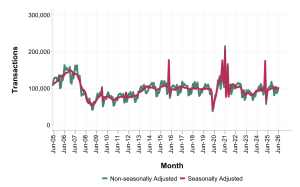
Source: Gov.uk
Of course, Stamp Duty is not the only factor. Interest rates, mortgage availability, house prices, planning restrictions and wider economic conditions all matter. HMRC itself notes that transactions fell sharply after the financial crisis, and that recent peaks and troughs have often been driven by tax deadlines, including temporary nil-rate bands and SDLT threshold changes.
That is exactly the point. A healthy housing market should not lurch around because buyers are racing to beat a tax deadline. Nor should people face bills of tens of thousands of pounds simply because they want to move home.
Speaking to Mortgage Introducer, Sebastian Murphy, Group Director at JLM Mortgage Network said “It’s a massive own goal. Burnham had the opportunity to do really well on this and he hasn’t.”
A cross-party consensus
The case for scrapping Stamp Duty is supported by economists and think tanks across the political spectrum. The Institute for Fiscal Studies has described Stamp Duty as an “economic nonsense” and the Mirrlees Review recommended replacing Council Tax and Stamp Duty on housing with a tax proportional to current property values.
The Institute of Economic Affairs has called abolishing Stamp Duty “the single best tax reform any government could make”, while the Centre for Policy Studies has described it as a tax on mobility and aspiration.
Onward, the centre-right think tank, has argued that abolishing Stamp Duty on primary homes would remove the transaction costs that stop people moving and make housing “much more likely to be allocated efficiently”. Its modelling suggested abolition could increase sales of homes worth £250,001 to £925,000 by around 22.5%.
This is not a left-wing or right-wing argument. It is a mainstream economic argument: Stamp Duty discourages moving, downsizing, upsizing and relocating for work. It makes the housing market less efficient and leaves Britain’s existing homes badly used.
The cost to families and downsizers
For someone buying a primary home, Stamp Duty is often a large upfront cost at precisely the moment when they are already stretching their finances. A family moving for more space may need a larger deposit, higher mortgage payments, moving costs, legal fees, furnishing costs and school or commuting changes. Stamp Duty adds another barrier.
For older homeowners, the effect is just as damaging. Many empty nesters would consider moving to a smaller, more manageable home if the costs were lower. That could release equity for retirement, reduce running costs, and free up larger homes for families. But Stamp Duty makes downsizing less attractive. It asks people to pay a large tax bill for doing something that would often benefit both them and the wider housing market.
What would scrapping Stamp Duty achieve?
Scrapping Stamp Duty on primary homes would therefore support three important goals.
First, it would improve housing mobility. People should be able to move when their circumstances change. A tax system should not trap them in homes that are too large, too small, too expensive to run, too far from work or no longer suitable.
Second, it would support economic growth. Removing one of the biggest transaction costs in the housing market would help people move for work, allow families to live in more suitable homes, and make better use of the housing stock we already have. Fairer Share’s own updated modelling describes abolishing Stamp Duty on owner-occupied homes as a key part of reform because it removes one of the most distortive taxes in the UK economy and supports labour-market flexibility and productivity.
Third, it would make the tax system fairer. Stamp Duty does not tax housing wealth consistently. It taxes only those who move. Two households can own homes of similar value, but the one that needs to move for work, family or health reasons faces a large additional tax bill while the other does not. That is arbitrary.
“Any future reform should improve housing mobility, protect first-time buyers and ordinary homeowners, but avoid creating new cliff edges or regional unfairness,” said Sam Kirtikar , CEO of The Mortgage Broker, in Mortgage Introducer.
Fairer Share believes Stamp Duty on primary homes should be scrapped alongside Council Tax and replaced with a Proportional Property Tax based on current property values. This matters because abolishing Stamp Duty cannot be considered in isolation. The revenue has to be replaced, local services need to be properly funded, and the system must be fair both to existing homeowners and future buyers.
Why a Proportional Property Tax?
A Proportional Property Tax would do that more sensibly. Instead of charging people tens of thousands of pounds at the point of moving, it would replace Council Tax and Stamp Duty with a fairer annual charge based on current property values. Existing homeowners would be protected through transition, including a cap on annual increases and deferral for those who cannot afford to pay from income.
Crucially, this is not about giving a tax cut to second-home owners or property investors. Fairer Share supports surcharges for second homes, empty homes and foreign-owned homes, so that reform helps primary-home owners and local communities rather than fuelling speculation.
The current system is indefensible. Council Tax is still based on 1991 property values. Stamp Duty punishes people for moving. Together, they distort the housing market, penalise ordinary life choices and hold back growth.
If a government proposed this system from scratch today, nobody would design it this way. The sensible reform is clear: scrap Stamp Duty on primary homes, abolish outdated Council Tax, and replace both with a fairer, simpler property tax that gets Britain moving again.