Written evidence: Tax after Coronavirus
In September 2020, Fairer Share submitted written evidence to the Treasury Select Committee’s important inquiry “Tax after Coronavirus”. This article details the submission and our recommendations to reform the UK’s unfair property tax system.
Introduction
- The Government’s efforts to help families and businesses across the UK in the wake of the pandemic have been commendable. Millions of households with concerns over their incomes have been supported through this period via the furlough scheme. However, it is clear that these measures cannot be in place for ever, especially as the Chancellor and the Treasury look at ways in which the public finances can be put back on to a sustainable footing in the medium term.
- As the furlough scheme and other support programmes come to an end, the Government will have to look at new ways of providing support to those affected by coronavirus while meeting its overall economic and fiscal objectives. Balancing these two issues is likely to necessitate changes to the tax system. Therefore, it is welcome that the Treasury Select Committee is using this period to reflect on some of the long-term issues (and potential opportunities) caused by the pandemic.
- Tax changes should focus on more than raising revenue. Policy makers should take a macro look at the tax system itself to ensure that it is not entrenching existing social and economic inequalities, and instead see it as a lever to support broader public policy objectives. A key part of this must be considering how tax can be used to create a fairer, more sustainable Britain, where wealth is distributed more equitably across the regions and nations. Indeed, this is at the heart of the Prime Minister’s levelling up agenda.
- In this submission we look at two areas of the tax system which are in desperate need of reform – Council Tax and Stamp Duty. In the wake of coronavirus, we propose that policy makers grasp the opportunity to remove regressive, outdated property taxes and replace them with a proportional flat rate tax on the value of the property (what we have called a Proportional Property Tax or PPT). A PPT would function as a form of wealth tax, with those who have greater property wealth paying more than those in poorer households. However, as PPT is based purely on property values, it represents a more deliverable option than other types of wealth tax that have been mooted which are based on a much broader definition of wealth.
- The introduction of PPT would have a broad array of economic and social benefits that we set out in more detail below. At its heart, replacing Council Tax and Stamp Duty with a PPT would be about creating a fundamentally fairer system; one that re-establishes the link between taxation and property price, providing a financial boost to 75% of UK households.
Key recommendations
i. Replace the Council Tax band system with a Proportional Property Tax (PPT) at a flat rate of 0.48% of property value
ii. To ensure a continuing link between local taxation and expenditure we suggest the headline PPT rate be split between a fixed national rate (going towards redistributive grants) and a floating local rate (that would be entirely spent locally and could be reduced or increased). Our initial proposal would be to have a 0.32% national rate and 0.16% local rate.
iii. There would be a higher rate of 0.96% of second, empty and non-resident owned homes
iv. Abolish Stamp Duty Land Tax (SDLT) on owner-occupied property
v. Property tax should be collected from owners, rather than tenants
vi. A deferral mechanism should be introduced for those owners unable to pay, with a modest interest charge included on the PPT – similar to the existing Deferred Payment Agreement scheme already in place to help people manage their social care costs
vii. Abolish majority of property tax reliefs and exemptions to make the system simpler
viii. Use recent improvements in technology to revalue all residential property, with annual revaluations thereafter
ix. Apply the property tax to undeveloped plots of land that have received planning permission from the local council
Key benefits
i. Put fairness back into the tax system by ensuring everyone pays the same % of tax on the value of their property. This would end the current situation where the effective tax rate on residential property is just 0.2% in London compared to 0.7% in the North East, over three times as much.
ii. Support “levelling up” and regional rebalancing by reducing bills for those outside London and the South East. A move to PPT would save Council Tax payers outside of London £6.5 billion per year, representing a huge boost to countless communities and their local economies. It would also provide further incentives for people to move out of London to benefit from lower rates as Covid has shifted the economy towards more home working.
iii. Simplify the tax system and cut the administrative burden for local authorities. 8.7 million households would be removed from property tax altogether, as the obligation to pay is transferred to the landlord. This would save tenants time and local councils £400 million in annual administrative costs.
iv. Increase the supply of housing by changing the incentives around building for residents and developers alike. In addition, PPT would make 1.4 million second homes, empty homes and undeveloped properties finally pay their fair share of tax, therefore incentivising their owners to rent, sell or develop their properties.
v. Our system is fully costed (see appendix) and revenue neutral, raising just as much from UK taxpayers as Council Tax and Stamp Duty currently do. Furthermore, PPT makes it simple for policy makers to understand how reducing or increasing the rate changes funding available centrally that is available for redistribution.
Issues with the current domestic property tax system
While property taxes are viewed as effective by economists as they are difficult to avoid, the current property tax system is failing against its policy objectives. Council Tax and Stamp Duty are entrenching regional and social inequalities and limiting overall housing supply in the market.
Council Tax
There is agreement across the political spectrum that Council Tax is a poorly-designed and highly regressive tax. Based on property values from almost thirty years ago, the IFS has said that it is “increasingly out of date and arbitrary.”[1]
It is also one of the most unpopular taxes with the general public. Polling conducted by Fairer Share in January 2020 found that just 29% of the public believe it is calculated fairly, only 26% believe their own bill is set at the right level, and only 33% are in favour of keeping the status quo.
The current Council Tax system benefits wealthy homeowners, many of whom own multiple properties, but penalises younger adults and low earners who end up paying higher effective tax rates than those in more valuable properties. There are a number of reasons for this:
Council Tax is based on property valuations that are almost thirty years out of date. It has not kept up with the huge growth in house prices, especially at the top-end of the market. It also contributes to the inequality between different regions in England. For example, the effective tax rate on residential property is just 0.2% in London compared to 0.7% in the North East.[2]
Due to the structure of the bands itself, homes at the bottom of a band pay proportionately more than those at the top of each band. There are also small differences between different bands, despite significant gaps in the value of properties.
It has well-intentioned, but distorted, exemptions for second homes and single occupants, which encourage under-occupancy and stop those who need homes most from benefitting.
Stamp Duty Land Tax (SDLT)
Unlike Council Tax, SDLT is a progressive, rather than regressive, tax. However, it has contributed to the current housing crisis by discouraging homeowners from moving. As the Centre for Policy Studies (CPS) notes, it is regarded as the “least fair tax in the country with the exemption of inheritance tax” and it is “overly complicated.”[3]
The knock-on effect from SDLT and its increasing rates is an inefficient use of existing property, as households are dissuaded from upsizing or downsizing. This has a real-world impact; it stops older people moving out of larger family homes they no longer need and inhibits a growing family from upsizing, all of which would lead to a more effective use of housing.
Combined with Council Tax, SDLT makes the current housing stock more affordable for investors and purchasers of second homes, who can pay the cost, compared to those around the country on lower salaries whose property is their primary home. It also excludes developers, incentivising them to land bank, increasing the strain and exclusivity of the market.
The government clearly understands that SDLT is a ‘bad’ tax, as seen by recent temporary increases to the starting threshold in response to the pandemic. However, this is only a stop gap measure and is due to end in March 2021. CPS’s research estimates that abolishing SDLT “would mean 25% more housing transactions,” demonstrating the cooling effect SDLT has on the market and the need for HMT to find a better long-term solution.[4]
Our solution: The Proportional Property Tax
A new property tax is needed which charges households based on their actual property wealth and ability to pay, encourages the efficient use of existing property, and is simple to understand. We propose introducing a Proportional Property Tax (PPT), which replaces the Council Tax band system, SDLT on owner-occupied property, and incentives and exemptions such as the Bedroom Tax and those for single occupants, second and empty homes. Our manifesto sets out our proposal in more detail, but we have summarised the main points below.
How it would work?
- The PPT would be set at a flat rate of 0.48% for owner-occupied property, no matter the value of the property or its location. This is the rate required to raise the same amount in revenue as the current system.
- In order to maintain the link between local expenditure and local taxation, we suggest that the rate will consist of two components. A fixed national rate which would go to central government for redistribution and a floating local ratewhich will go straight to the local authority to be spent locally. An indicative split could be 0.32% for the national rate and 0.16% for the local rate.
- The flexible rate allows councils two broad approaches; operate efficiently to reduce their costs and pass the saving on to residents or increase the local rate and invest that in the community. Lower rates get capitalised into higher property values increasing revenue and providing opportunity for further reductions. An alternate approach harnesses the link between many forms of investment (good schools and infrastructure) and rising property prices which would allow the rate to be reduced as property prices rise and see local communities benefit from much needed investment. Crucially it would be the local community’s choice on which option to adopt.
- PPT should be collected not from tenants, but directly from owners, who are in a better position to pay. This would bring England into line with international practice.
- For second, empty and non-resident owned homes, including homes of overseas owners, there should be a higher rate of 0.96%. For primary residences SDLT will be abolished but will remain in place for second homes and non-resident buyers. These receipts make a significant contribution to funding for redistribution. This property tax would also be applied to undeveloped plots of land that have received housing permission, encouraging developers to start building and increasing the supply of homes.
- A deferral system should also be introduced for those owners who can prove they are generally unable to pay; this would see the tax and a modest interest charge paid at a later date or when the home is sold. Such a system is already in place for social care, with local councils offering Deferred Payment Agreements for the cost of care, and so should be feasible to expand. This would help avoid debt issues such as bailiffs or complaints from households that they are unable to pay (an issue which is likely to increase as a result of Covid).
- For the introduction of the PPT, there will have to be a revaluation of all residential property. This should still be led by the Valuation Office Agency (VAO), though valuations should be derived from actual sales data and recent changes to house values in local areas. The Government has stated its ambition to be guided by data and technology to improve efficiency and cut costs – building an algorithm similar to those used by Zoopla and Rightmove to calculate data and provide accurate values for each home would help achieve this. Under such a system going forward, the VAO would be able to revalue properties using its algorithm each year, with properties being taxed on their average value across the last three years.
- Our system is fully costed (see appendix) and revenue neutral, raising just as much from UK taxpayers as Council Tax and Stamp Duty currently do. While many have convincingly argued for increased council budgets to pay for essential public service needs, we believe calling for an increase in taxes is beyond the scope of this paper.
What are the benefits?
Putting fairness back into the tax system
- As set out above, the flaws in the current system mean that Council Tax is only weakly linked to property values. A person living in a property worth £100,000 pays around five times more tax, as a share of property value, than someone living in a property worth £1 million.
- Not only is this fundamentally unfair, it is having a significant negative impact on the least well off in our society. This is especially the case as younger adults and lower earners are concentrated in lower Council Tax bands, and therefore pay higher effective tax rates than wealthier and older households.
- The effect of the current system is that those on lowest incomes are being presented with bills that are simply unaffordable and disproportionate to their earnings. As of March 2019 the total amount of outstanding Council Tax debt in England was £3.2 billion, an increase of over 20% in just four years. This situation will only get worse as households struggle to manage falling income as a result of Covid and local councils look to restore their finances through ever increasing Council Tax bills.
- Charging a flat rate would remove this unfairness from the system, ensuring we are taxing people fairly based on the value of their property. Overall, moving to PPT would see 18 million households paying less tax, with 75% of households better off. Additionally, PPT includes a deferral mechanism, allowing outstanding bills to be paid when the household can afford it or at the sale of the property, giving people necessary breathing space during this difficult period.
Supporting “levelling up” and regional rebalancing
- As we have seen, Council Tax under-taxes larger and more expensive properties – concentrated in London and the South East – while overtaxing cheaper homes in other parts of the country. This effect has been magnified because, since the inception of Council Tax, properties have not been revalued to keep up with property price increases – which again have been largest in London and the South East.
- The current system has led to the deeply unfair situation in which those parts of the country with greater property wealth pay relatively less in Council Tax. The effective tax rate on residential property is just 0.2% in London compared to 0.7% in the North East, over three times as much. This is manifestly regressive, penalising those who live in the regions and serving to entrench existing regional wealth inequalities.
- A move to PPT would save Council Tax payers outside of London £6.5 billion per year, representing a direct fiscal transfer to those outside of London and the South East. While this change is fair in its own terms and would help the Prime Minister to deliver his levelling up agenda, it would also be a targeted relief to help those communities most struggling to recover from the economic impacts of Covid-19.
- Reducing property taxes in the regions would also provide greater incentives for people to move out of London to benefit from lower rates. While lower rates are probably not a key driver in themselves, it would capitalise on the effect of Covid which has seen a fundamental shift in the economy towards greater home working. More people moving to the regions would benefit those communities both in the short-term from relocated workers generating greater footfall on local high streets and the longer-term through raising the quality of jobs available in these areas.
Simplifying the tax system and cutting the administrative burden for local authorities
- The current system is an administrative burden on both people and councils. In moving to PPT 8.7 million households would be removed from property tax altogether, as the obligation to pay is transferred to the landlord. Making the landlord responsible for the tax would reduce the number of rate payers (due to multiple ownership).
- In addition, every year over 750,000 English house buyers have to pay Stamp Duty or fill out forms to declare exemptions. Ending SDLT would make house buying simpler and cheaper, speeding up the overall house buying process, and helping to stimulate the housing market as it emerges from the Covid induced deep freeze.
- Taken together, these reforms would save tenants time and local councils £400 million in annual administrative costs – a vital lifeline when council budgets are already stretched beyond capacity following Covid.
Increasing the supply of housing
- Recent government data shows that over 216,000 homes have been empty for over six months, while 7.7 million homes claimed the single occupant discount in 2018.[5] One recent study by academics at UCL estimated that housing worth a total of £123 billion in Britain is rarely used.[6] Exemptions in the Council Tax system have reinforced this trend; by under-taxing larger and more expensive properties relative to other homes.
- In taxing housing transactions Stamp Duty discourages the efficient use of our existing stock of housing. This is further exacerbated because Council Tax does not apply to undeveloped sites that have already received planning permission from their local authority thereby incentivising developers to delay construction in the expectation of rising land prices, a phenomenon known as “land banking.”
- By making 1.4 million second homes, empty homes and undeveloped properties finally pay their fair share of tax, this would incentivise their owners to rent, sell or develop their properties – contributing to an increase in the overall housing supply in England.
- PPT would also change the incentives for both residents and developers to support new house building. For example, if government linked the budget for a local area to a local homes target, residents would clearly see the link between supporting development and spreading the tax burden between more property owners. Equally PPT is likely to increase demand in areas of the country where incomes are lower, by significantly reducing the cost of property tax relative to the price of property. Therefore the proposal should be seen as complimentary to the Government’s recently published planning paper, “Planning for the Future.”
What are the challenges?
- How would you value the land?
It is perfectly possible to value land separately from property for the purposes of taxing only the former. The ONS already produces estimates of land value in the UK, though these are not detailed enough for modelling the introduction of a CLL.[7] Further evidence that land valuation is perfectly feasible comes from international experience. This includes Estonia, Australia and Denmark, as well as Jamaica, Kenya, New Zealand, South Africa, and certain parts of the United States.
- Why not simply reform Council Tax bands?
By its nature, Council Tax is highly regressive in terms of property value and reforming the bands would likely have limited impact on the current situation. The IFS have argued that “revaluation alone would have little effect on the average tax bills of different household types.”[8] While HM Treasury could consider additional Council Tax bands at the top end to tax wealthier households, this would not produce a fairer system in the long run as the majority of households will still be paying Council Tax based on an outdated valuation.
- Doesn’t this mean councils outside of London and the South East will actually lose money?
No. The PPT will not decrease tax revenues for local authorities. The ‘national rate’ portion of the tax will be collected by central government and distributed to local councils accordingly to ensure their overall revenue remains the same. Given the scale of loss in local government funding as a result of Covid-19, the government is likely to have to introduce greater central funding top-ups to local government than was previously the case anyway.[9]
- How is this different to the poll tax?
The poll tax was a fixed charge on each individual, regardless of their wealth, and therefore highly regressive. PPT represents a much fairer, and administratively easy system that makes property taxes progressive.
- Is it fair that parts of London and the South East will end up paying more tax?
Properties in London and the South East have seen the greatest increase in value since Council Tax was introduced. This means that for almost three decades they have benefitted from lower Council Tax bills, enabling these households to spend more on mortgages. People buying in London and the South East will also benefit the most from the removal of SDLT, given this is already linked to property prices.
Conclusion
The coronavirus pandemic has starkly highlighted the existing inequalities that currently exist within the UK. Rightly, as we begin to recover from the crisis, policy makers are looking at how we can do so in a way which tackles the social and economic issues facing the country. The Government’s ambition to increase fairness and level up the regions is the right one. Targeted investment in skills and infrastructure is part of the way out of this crisis, but the answer also lies much closer to home for many families and individuals – the tax system.
Replacing outdated and unfair property taxes with PPT would boost the incomes of millions of people across the UK. With international inspiration of similar proposals to PPT that have been implemented successfully, and significant advancements in technology over recent years, we believe that now is the right time both politically and economically to fundamentally change the way in which the UK’s property tax system works and ensure it helps create a fairer andmore equal society.
Leading Conservative MP backs Fairer Share
This article first appeared in Conservative Home on the 23rd September.
The battle against the Coronavirus is far from over, but as we begin to look at how to achieve what the Prime Minister called “building back better”, the time is right to think about what we as Conservatives believe “better” really means.
For me that must include creating a fairer society. By hitting the most vulnerable groups hardest, Covid-19 has sharply exposed the profound inequalities that exist in Britain. These are divides that a modern Conservative Party must be committed to eradicating. Now is the moment to do so, and as a fundamental part of that we have to look at how we tax people.
While it might not be the first thing that comes to mind, replacing council tax and stamp duty should be part of the roadmap for a fairer Britain. It’s a fundamental principle of taxation that taxes should be simple, transparent and fair, yet these taxes achieve none of those things.
Council tax is based on property values that are thirty years out of date, taxes low-value homes at a much higher rate than high-value properties and pushes millions of households into debt. It is emblematic of a broken system that is no longer fit for purpose.
Ultimately these taxes are unfair, complicated and block aspiration. Unfair because the poorest find themselves hit hardest. Complicated because they are difficult to understand and command an intricate web of bureaucracy to administer. And they hinder aspiration by taxing property transactions and discouraging people from moving home.
Since being elected to Thirsk and Malton in 2015, and as Chair of the APPG on poverty, I have seen first-hand how council tax inflicts immense suffering on some of our most vulnerable citizens while failing to fulfil the most basic tasks of a functioning property tax.
It has a devastating impact on low-income households, who if they are unable to pay are aggressively pursued by local authorities and debt collection authorities – and in some cases even imprisoned. According to Citizens Advice, 40 per cent of problem debt can be apportioned to council tax, up from 21 per cent in 2011. The Covid-19 crisis has only exacerbated the situation, with an extra £700 million in council tax debt accrued by 800,000 struggling UK households since March.
As an officer of the APPG on Land Value Capture and a former member of Parliament’s Housing, Communities and Local Government (HCLG) Select Committee, I’ve become depressingly familiar with council tax’s many structural flaws. Chief among these is its failure to keep up with the substantial increases in property values that have taken place in recent decades, particularly in London and the South East.
This has deprived the Treasury of crucial tax revenues. While it is right that property owners are able to enjoy the fruits of their investment, it is only fair that in return they are taxed on the actual – rather than 1991 – valuations of their homes.
I have come to accept that council tax is in need of replacement – the problems will not be solved simply by adding one or two more property bands. I was therefore delighted to discover that a new grassroots campaign, Fairer Share, has put forward credible and costed proposals to do just that. It proposes replacing council tax and stamp duty with a proportional property tax (PPT) which would tax all homes at exactly the same rate based on up-to-date property values.
These proposals have two key merits in comparison to council tax: they are fairer and they are simpler. By taxing homeowners on current property values, they would ensure that wealthy homeowners pay an amount of tax that actually reflects the value of their homes while providing a much-needed tax cut to millions of low- and middle-income households.
This would give a real boost to the UK’s regions, the majority of which are hugely disadvantaged by the current system. This is in stark contrast to the status quo, under which a person living in a property worth £100,000 pays around five times more tax as a share of property value than someone living in a property worth £1 million – the equivalent of charging more VAT on a Ford than on a Ferrari.
In place of the administrative challenge of council tax, in which properties are taxed through a confusing and distorting system of bands and exemptions, the PPT would apply a single rate of tax – 0.48 per cent of property value – to all homes. Owners rather than tenants would be responsible for the tax, removing over 8.7 million households from property tax altogether and saving councils an annual £400 million in administrative costs.
To incentivise more efficient usage of existing property, a surcharge on second, empty and offshore-owned homes would be introduced, as well as on plots of land that received council planning permission yet have been left vacant by developers. The policy is revenue neutral – raising the same amount of money for the Treasury as the scrapped taxes currently do.
To maintain the important democratic link between local expenditure and local taxation, Fairer Share recommends that the 0.48 per cent rate should consist of two components. A fixed national rate (0.32 per cent) which would go to central government for redistribution and an initial floating local rate (0.16 per cent) which would go straight to the local authority and could subsequently be moved up or down by that authority. In this way local authorities retain flexibility over taxation and voters can still judge them on value for money.
And importantly, this approach includes the complete abolition of stamp duty land tax (SDLT) on owner-occupied residential property. By taxing properties when they change hands, stamp duty discourages homeowners from moving – such as a young household looking to buy a family home or an older couple looking to downsize – and prevents the efficient use of our existing supply of housing. This also has wider economic consequences when, for example, it leads to people turning down job opportunities outside of their area due to the cost of moving home.
The Government has already acknowledged the harm stamp duty causes by introducing numerous exemptions from the tax, including most recently a temporary holiday on all purchases up to £500,000 announced last month. With the UK likely facing an extended economic downturn, the Chancellor should now take further action to support the housing market by fully abolishing stamp duty on owner-occupied property.
While replacing taxes as fundamental as council tax and stamp duty – responsible for raising £50 billion annually - is no walk in the park, I firmly believe it is the right thing to do. The current system of council tax and stamp duty is simply unfair and inefficient.
Local authority finances have been hit hard recently. Replacing these taxes with a better system will put them on a stronger foundation for the future. The PPT is simpler and easier to operate, and revaluations can be carried out regularly, quickly and easily using the latest technology and on a desktop basis.
The Fairer Share campaign has provided us with an excellent blueprint for reform. I urge the Chancellor to take its proposals seriously, starting by announcing a fundamental review of council tax at this year’s Autumn Budget. This would mirror the Treasury’s ongoing review of business rates, the other half of our dysfunctional property tax system.
While it would take time to get the details right, introducing a proportional tax on property in the UK would be an excellent way for our party to demonstrate our commitment to “levelling up” and to do something meaningful for the many new constituencies we have won across the country.
I urge anyone interested in Fairer Share’s proposals to visit their website here or get in touch with me, and to share this article and the wider campaign with their networks. I will also be hosting a live webinar and Q&A with the Fairer Share team in the coming weeks – details will be posted on my website in due course.
Kevin Hollinrake is MP for Thirsk and Malton.

Supporter letters | The most unfair tax in the country?
Dear Fairer Share,
I’m a UK taxpayer and have been since I was 16 (40 years!). I don’t mind paying my tax - it makes me feel like I’m contributing to society, and in most cases the more you earn, the more you pay.
Thankfully, the Government uses our taxes to pay for public services like the NHS, schools and of course, to maintain our country's infrastructure, spending on things like highways and train lines. As a user of all of those throughout my life, I’m happy to pay my share in tax.
However, I have always had a problem with COUNCIL TAX.
I live in County Durham and currently pay £2,263 for my band D property which is valued at around £180,000. This works out at 1.25% of the value of my home.
And there are plenty that have it even worse. Friends of mine live in a band A two-bedroom terraced house in Easington Colliery. They pay £1,498 each year in tax. Their property is on the market for £30,000, which means they are paying 5% of the house value in tax EVERY year.
Meanwhile, on Zoopla I can see a band H £9.8 million six-bedroom detached house in London pays £1,560 each year in Council Tax. This is just 0.016% of the property value.
When you look at it like this, council tax is probably the most unfair tax in the country.
Friends and colleagues have heard me bleating on about this for years, so I was very pleased to finally come across your campaign. Using your calculator, I worked out that your suggested tax rate of 0.48% would mean I pay £864, saving over £1,500 every year. In my area, there are thousands of people that would benefit so much from this type of yearly saving. And it is actual pounds in our pockets.
I really hope that the campaign will be successful - I’m sure there are plenty like me that think the current system is unjust and unfair.
I will continue to share the campaign with friends and family, and will keep a lookout for any updates. Please let me know if there is anything else I can do to help.
Susan M
Peterlee, County Durham
Open Letter to the Chancellor of the Exchequer | Reforming our Residential Property Taxes
Below is the Open Letter sent to the Chancellor of the Exchequer, signed by parliamentarians, think tanks, charities, tax reformers and academics. An abbreviated version was published in The Sunday Times on 06/09/20.
We live in a society that has come to be seen by many as unequal, creating a “geography of discontent”.
The top 10% of UK households possess 45% of all wealth, while the bottom half own just 8%. Furthermore, research shows that nearly three quarters of the British public agree that “rich people get an unfair advantage”, while just 30% feel that “British society as a whole is fair”.
We now face the challenge of addressing the Covid-19 pandemic. In many ways, the pandemic has brought out the best in our nation as social bonds were strengthened to face this unprecedented crisis. Regrettably, the pandemic has also highlighted deeply entrenched social and economic divisions. It has inflicted a particularly heavy economic toll on those in low-paid and insecure work, young renters, and ethnic minorities. It is the less well-off who have paid the heaviest price.
As we emerge from the immediate crisis of the pandemic, we have an opportunity to rebuild a fairer economic settlement across the country and between the generations. A chance to create a more just society and crucially, a system people believe is right. One that leaves our public services more resilient to face future challenges. A society where hard work brings both rewards and obligations accepted as reasonable by everyone.
As the process commences, we believe reforming Britain’s property taxes are an urgent and important part of the solution.
Council Tax is poorly designed, out of date, and unpopular. It is based, in England and Scotland, on property valuations that are almost 30 years old and therefore bear no resemblance to the realities of current pricing levels. Its structure ensures that all those in the same band pay the same amount of tax irrespective of the actual value of a property. A person living in a property worth £100,000 pays around six times more tax, as a share of property value, than someone living in a property worth £1 million. This places the heaviest burden on the young, low-earners, and those living in less prosperous parts of the country, who typically live in modest properties.
Council Tax is increasingly putting lower-income families into debt. As of March 2019, the total amount of outstanding Council Tax debt in England was £3.2 billion, an increase of over 20% in just four years. The effect of Covid-19 has only exacerbated the situation, with an extra £700 million added in outstanding Council Tax debt from over 800,000 UK households since March.
Council Tax’s partner in crime is Stamp Duty. Stamp Duty is a better designed tax than Council Tax in the sense it is progressive, linked to property values and is more generous to young people thanks to its first-time buyer discount. We welcome the Chancellor’s Stamp Duty holiday but it does not go far enough. By taxing property transactions, Stamp Duty discourages homeowners from moving that would lead to a more effective use of housing. This has wider economic consequences when it leads to people turning down job opportunities outside of their local area due to the cost of moving home.
Council Tax and Stamp Duty have also played their part by fuelling house price inflation and encouraging the inefficient use of property and land. By failing to keep up with rapid house price growth over the past three decades, Council Tax has deprived the Government of crucial tax revenues and artificially increased the relative attractiveness of housing as an investment, inflating the housing bubble.
The result is that owner-occupiers are increasingly being crowded out by investors and purchasers of second homes, who now make up roughly a quarter of all residential property sales. The regressive nature of Council Tax combined with Stamp Duty’s tax on transactions combine to discourage the efficient use of our existing stock of housing.
Solving the housing crisis will require a multi-pronged approach, including more building and modernised planning rules as well as tax reform. In contrast to the current system any reform should have principles of fairness and equality at its core. A new economic settlement, including a fair system of property taxation, is urgently needed to restore social cohesion.
What makes a tax fair is its ability to raise sufficient revenues to pay for the public services we all value and depend upon, while distributing that burden based on people’s ability to pay. Economists see property taxes as useful because they are hard to avoid, as well as being less economically damaging than taxes on people’s incomes or businesses.
A new property tax should therefore: charge people based on their actual property value and ability to pay, encourage the efficient use of existing property, and be simple to understand.
The Government has set its mind on narrowing the divide, promising to “level up” Britain’s regions. Reforming Council Tax and Stamp Duty with a fairer system would be a good start on achieving this vision.
We welcome the Treasury Committee’s new inquiry into “Tax after Coronavirus” and urge the Government and HM Treasury to take this opportunity to conduct a thorough review of Britain’s residential property taxes.
Signatories
Tom Burgess, Chair, Coalition for Economic Justice
Sir Vince Cable, former leader of the Liberal Democrats
Wendy Carlin CBE, Professor of Economics, UCL
Andrew Dixon, Founder, Fairer Share
Liz Emerson, Co-founder, Intergenerational Foundation
Kevin Hollinrake, Conservative MP for Thirsk & Malton
Gavin Kerr, author of “The Property-Owning Democracy: Freedom & Capitalism in the 21st Century”
Matthew Lesh, Head of Research, Adam Smith Institute
Polly Mackenzie, Chief Executive, Demos
Robin McAlpine, Director, Common Weal
Professor John Muellbauer, Institute for New Economic Thinking, Oxford Martin School
John Myers, Co-founder, YIMBY Alliance
Robert Palmer, Executive Director, Tax Justice
Andrew Purves, author of "No Debt, High Growth, Low Tax"
Ben Rich, CEO, Radix
Carys Roberts, Executive Director, IPPR
Will Tanner, Director, Onward
John Tizard, Head of Strategy, Taxpayers Against Poverty
George Turner, Director, Tax Watch
Torrin Wilkins, Director, Centre Think Tank
Dan Wilson Craw, Director, Generation Rent
Dr Wanda Wyporska, Executive Director, The Equality Trust
Reuben Young, Director, Priced Out UK
Conservative Progress | The Case for a Proportional Property Tax
This article first appeared in Conservative Progress on the 30th August and was written by Tom Spencer, Chair of City Conservative Society.
Our system of council tax is a mess! Based upon estimates of property value conducted in 1991 it acts as a deeply regressive system whereby the richest pay just three times more than the very poorest, despite their incomes being eight times more.
This is particularly damaging for some of the poorest regions in the UK, this is because house prices tend to be higher to wealthier areas. Indeed, official estimates claim that the average house in London is six times what it was in 1995; this is compared to just three times as much in the North East. Thus, the very wealthiest in the very wealthiest areas are paying an insufficient amount of tax when compared to the very poorest in the very poorest areas.
Council tax is one of those taxes which gets extraordinarily little attention given to it, however, for the average household it makes up 3% of their annual income.
Furthermore, as of March 2019 the total council tax debt amounted to £3.2 Billion, a 20% rise over the past 4 years. Therefore, it is a huge burden on ordinary families up and down the country, and deserves to have more scrutiny given to it. This is particularly important when considered in relation to the Governments levelling up agenda. Those towns who incidentally happen to be paying too much council tax, also happen to be towns who the Government so desperately need to keep if they are to keep the old Red Wall from returning to Labour.
We can illustrate this problem with a concrete example: a modest home in Middlesbrough valued at £150,000 will pay £1,702 in council tax. Whereas an £8,000,000 home in Westminster will pay just £1,560 in council tax. This means the former is paying 1% of their house value in tax, and the latter is paying just 0.02%.
Indeed, the map to the right shows this perfectly. This shows where the impacts would be most impactful of a mere revaluation of council taxes. It reveals that the Northern seats that the Tories won in 2019 would be the biggest beneficiaries of such a scheme.

However, even if a pure revaluation of Council Taxes was done this would not suffice to fix the system. It would still be the case that Band H houses would be paying vastly too little and Band A houses would be paying vastly too much.
Thus, what is needed is not simply reforming the current system, but a complete remodel of how we fund local government. The best idea to address this is proportional property taxes. This view is best advocated by the team at Fairer Share.
What they propose is a flat council tax placed at 0.48%. This would be sufficient to completely remove the need for council taxes and stamp duty land tax – an equally problematic tax that helps further the housing crisis by disincentive moving house and disincentives downsizing, as I argued previously. As well as the obvious benefits this brings by removing two bad taxes, it also presents many benefits in itself.
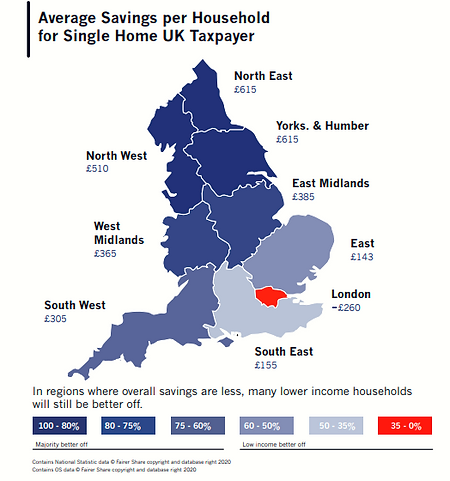
Firstly, it is extraordinarily simple. A huge benefit of flat taxes is the administration costs become exceptionally low, and avoidance becomes next to impossible. Secondly, the cost savings for average families are truly remarkable. If their plan was implemented in full: 18 million households would pay less tax, 75% of households would be better off, 8.7 million households wouldn’t have to pay any council tax whatsoever and over 750,000 buyers would no longer have to pay stamp duty.
This plan would also do a lot to help address Britain’s rampant inequality. This is particularly important as Britain is the most regionally unequal country in the industrialised world. This tax would see the most deprived regions substantially better off to a greater extent than a mere revaluation would present. This includes annual household savings in excess of £600 for some of the countries most deprived areas in the North East, as illustrated by the map on the left.
To summarise, a proportional property tax represents a much-needed shakeup to local government funding. It would create a more simple system, as well as a more progressive one that will create huge savings for the people who need them most. This will do a huge amount to support the levelling up agenda of the government, as well as help to show that Conservative governments are about more than just delivering Brexit; they’re about delivering sensible reform that will help the people of Great Britain.
Tom Spencer, Chair of City Conservative Society
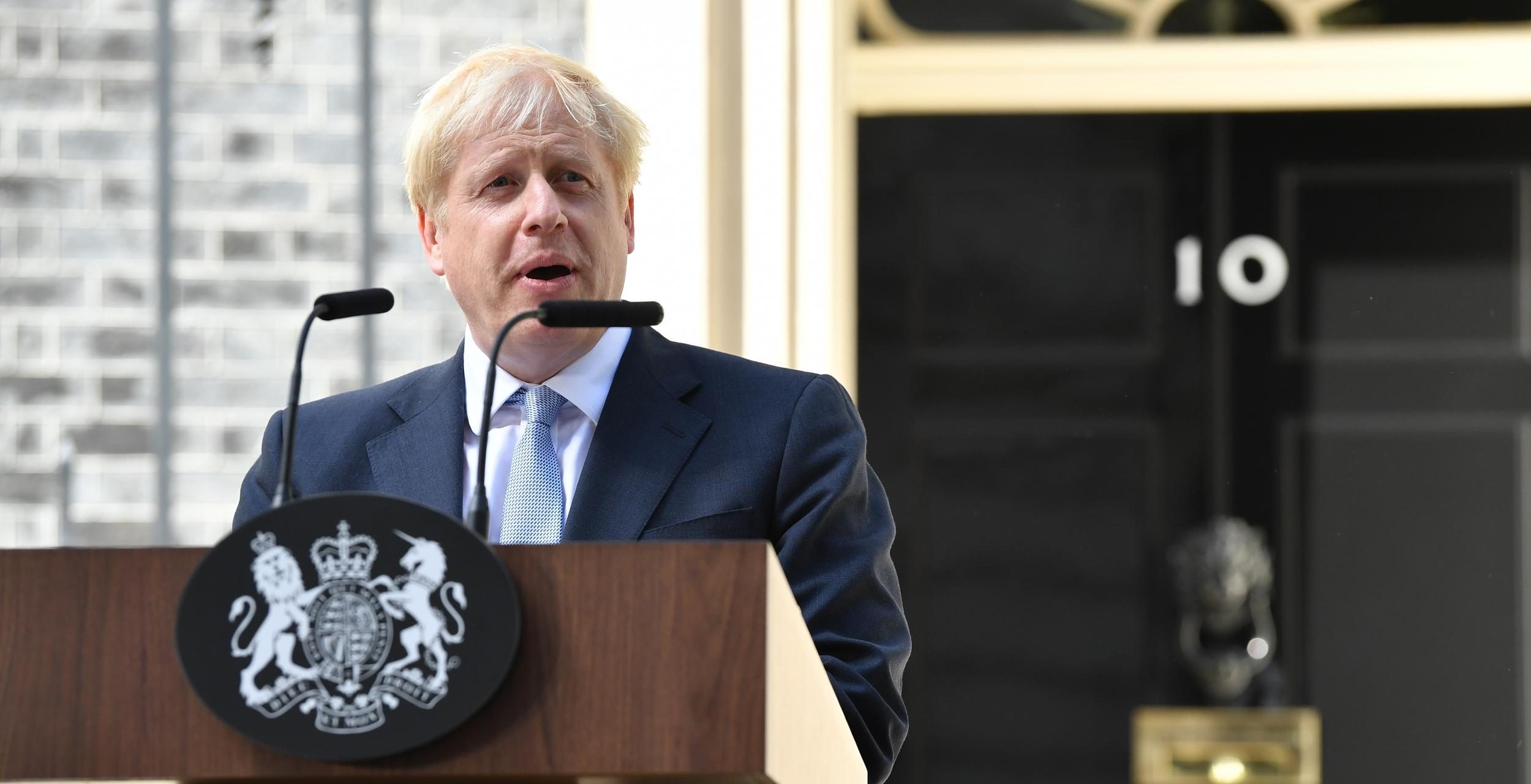
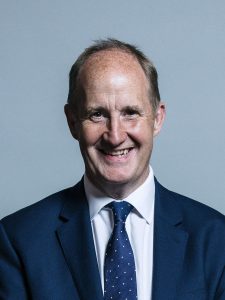
Kevin Hollinrake MP - Letter to the Prime Minister
This letter, written by Kevin Hollinrake MP for Thirsk & Malton, was sent to Prime Minister Boris Johnson on August 25th.
Dear Prime Minister,
Some like-minded colleagues and I would be very grateful for a few minutes of your time to discuss the importance of reforming property taxation as we seek to level up our country equitably and successfully following the cv19 pandemic.
It is my view that property taxation is long overdue radical reform. Council Tax is a poorly conceived method of funding local services and it enjoys almost no support from across the political spectrum, as reports from Institute for Fiscal Studies, IEA, IPPR and Resolution Foundation, amongst others, demonstrate. It also sees areas of the country with greater property wealth paying relatively less in Council Tax as a percentage of residential values. The effective tax rate on residential property is just 0.2% in London compared to 0.7% in the North East. Stamp Duty meanwhile acts as a simultaneous break on social mobility and willingness to downsize. Recent Stamp Duty announcements are welcome, but they have not addressed the fundamental inequities associated with taxing property transactions.
I have been working with Fairer Share, who have called for the replacement of Stamp Duty and Council Tax with a Proportional Property Tax. Their calculations suggest that, if levied at 0.48% of estimated property value, approximately 18 million households in England will see a reduction in their tax bills. This policy is revenue neutral as savings are offset by increases for multiple homeowners, foreign property investors, land banking developers and those residing in the most expensive properties (with deferral options available for the elderly and asset rich/cash poor). The campaign's petition has already received over 45,000 signatures, garnering a great deal of support in the regions. Some, of course, will argue that this is a wealth tax, in my view it is no more so than Business Rates, which is also a proportionate property tax.
I have discussed the proposals with colleagues and there is support for simplifying property taxation whilst making the system more equitable. It is vital, as we recover from cv19, that we continue to level up those areas repeatedly and scandalously left behind. I see this as a fair and fundamentally Conservative way to put more money back in people's pockets and for them to spend as they see fit as they ultimately know best. I look forward to hearing from you.
Yours sincerely,
Kevin Hollinrake MP
Member of Parliament for Thirsk & Malton
Reforming Council Tax will help to deliver the aspirations of 'Planning for the Future'
Earlier this month, the Government published a radical and exciting new white paper, Planning for the Future, setting out major reforms for the planning system with the ambition of increasing and revitalising the UK’s housing stock.
Primarily, the reforms aims are to increase the speed and volume of housing developments, to reduce the cost of housing (particularly for prospective younger buyers), and to ensure genuine community involvement in local developments and practices.
As with our Fairer Share campaign, the white paper appears to take a certain amount of inspiration from the late philosopher Roger Scruton, who held firm in his belief that:
“People do not only want beauty in their surroundings. They are repelled by ugliness, which is a social cost that everyone is forced to bear. Such buildings destroy the sense of place and undermine the spirit of community.” as noted in the Living with Beauty: report of the Building Better, Building Beautiful Commission, of which Scruton was co-chairman.
The white paper’s welcome adoption of locally-developed design codes would undoubtedly move the UK’s planning legislation further inline with what Scruton envisaged for the majority of his career. As always, it is the detail of these design codes, paired with the level of commitment to community involvement that will determine the extent by which Scruton’s vision is realised. But there is a clear aspiration from the Government to incentivise developers to improve the quality of homes they build.
In addition to the issue of building aesthetically pleasing and appropriate homes, the white paper rightly frames the discussion with the consistent theme of building more homes to meet the UK’s housing needs — with consent from the local community becoming a crucial part of the planning process. It is here where Council Tax reform can play its own role alongside planning reform in achieving the Government’s vision.
Historically—as noted throughout the paper—one of the major barriers around planning has been NIMBYism. Under the current system, there is a financial incentive for local residents to object to developments — fewer homes mean greater demand and higher prices for their properties. The losers are the government and local authorities, who are forced into making costly interventions to the market, and prospective buyers trying to get a foot on the property ladder. A proportional property tax combined with the Government’s planning reforms can be used realign the incentives and costs of planning objections more fairly.
For example, if government linked the budget for a local area to a local homes target, residents would clearly see the link between supporting development and spreading the tax burden between more property owners. Conversely local residents may choose to limit supply, increase prices and (as tax is proportional to price) pay more in property tax which the Government would then spend on increasing effective housing supply elsewhere through more homes or reducing travel times to existing areas with underused supply. This realignment can only exist with a tax linked to property wealth.
Furthermore, the variability of Council Tax across the country alters the potential incentives for developers. For example, in Westminster the likely buyers and tenants for new housing developments would be relatively unaffected by the local Council Tax rate. Not only is Council Tax lower than other parts of the country but household incomes are higher in Westminster, meaning households finances would be less impacted by any increase to the tax rate. However, if you take Hartlepool as an example, where the average household income is significantly lower, the high relative cost of £2,090 a year in Council Tax for a Band D property worth under £200,000, could dissuade prospective buyers and tenants from moving to the town, therefore disincentivizing the building of new developments there.
The removal of Stamp Duty would also assist in advancing the objectives of these planning reforms. Removing the tax on property transactions stimulates the housing market by increasing the incentive to move home, as has been seen with the recent increase in the Stamp Duty threshold to £500,000. The removal of Stamp Duty reduces the cost of relocating for those looking to pursue job opportunities elsewhere in the country. This will improve both labour mobility and workplace productivity. A greater incentive to move would result in the more efficient use of the UK's housing stock, which in turn would lead to an increase in the number of new residential developments and the volume of homes in the UK.
Council Tax reform can act as a more than useful facilitator to create an environment that spawns the type of developments to which the government is clearly aspiring, namely: attractive homes that stand the test of time, are desired by the communities they inhabit, and are fit for purpose in the 21st Century.
Find out more about Fairer Share’s proposal by visiting our campaign page.

Andrew Dixon | An interview with the founder of Fairer Share

Andrew Dixon is founder of ARC InterCapital, founding trustee of The Woodhaven Trust, and an Enterprise Fellow at The Prince’s Trust.
In 2020, Andrew launched Fairer Share to reform England’s poorly designed, out of date, and unfair property tax system.
In this interview he talks about his motivations for setting up the campaign, its proposals, and how to get involved.
How do you think the world has changed over the last few years?
AD: The big story of the last few years has been growing levels of social discontent. Many people feel they have been left behind by economic growth, are struggling to keep up with the higher costs of living, and are frustrated with politics.
One of the main reasons for this discontent is rising levels of inequality. In the UK, the top 10% of households have 45% of the country’s wealth while the bottom 50% own just 8%.
Add to this regional and intergenerational inequality:
- The UK has greater levels of regional inequality than 28 other developed countries, including the US, France, and Germany, according to a recent academic study.
- 60% of families headed by people born in the early-1950s were home owners by the age of 33 compared to just 40% of those born in the early-1980s, according to the Resolution Foundation.
As a country, we are bound together by ties of mutual responsibility, social trust and most importantly a sense of fairness. We feel passionately about our fellow citizens and their circumstances and want to live in a society where everyone has a fair shot at life. When we see something which is grossly unfair, it bothers us.
This sense of fairness is part of our national character. As a country, we have a proud history of pulling together to fight for each other’s rights and liberties – from the signing of the Magna Carta to the creation of the NHS. Our society was founded on principles that seek to uphold fairness and equal opportunities for all in education, work, health, justice, security and living standards.
How has growing inequality changed how people feel about the country?
AD: Despite our strong sense of fair play, people increasingly feel that the country is only working for the country’s most fortunate people and everyone else just has to get by on their own. 71% of the public say there is “one rule for some and a different rule for people like me.” According to one recent survey, 69% say “rich people get an unfair advantage.”.
How has growing inequality impacted our politics?
AD: People feel alienated from politics. This has fuelled the rise of anti-establishment parties on the left and right and, I believe, was one of the reasons behind the Brexit vote. Regardless of your view on Brexit, the Leave campaign was undoubtedly successful at tapping into people’s frustrations.
Has coronavirus affected this trend?
AD: It has made the situation worse. It has shined a light on the growing divides in society. On one hand, it has revealed the deep flaws in our broken adult care system on which many vulnerable and elderly people depend. Many of our care homes have suffered from decades of underinvestment, especially in less well-off parts of the country.
People with pre-existing health conditions, those in insecure and low-paid work, and ethnic minorities have been adversely affected by the pandemic. People in lower paid jobs are more likely to work in industries that expose them to the virus, such as retail and construction, and as contractors do not have many employment protections, they have continued working despite the obvious risks.
What do you think the future holds?
AD: If we don’t tackle the deep-seated problems endemic in our society, we will all lose out. Inequality will increase, the country will become more divided, and frustration will continue to rise. We will have a country that is fractured, with tensions rising between the UK’s regions and between the generations.
We need to make sure that society is working for everyone. We need to bridge these divides.
Do you think this had an impact on the 2019 General Election?
AD: Regardless of your opinion on the election result, the Conservative Party’s manifesto promise to ‘level up’ the country resonated with voters outside of the south east. Over the last few decades, London, in particular, has benefited from economic growth, while the rest of the country has stagnated. Suddenly, you had a political party that said they were going to tackle this problem. This won over huge numbers of voters in the north of England and led to the collapse of the Labour’s ‘Red Wall’ seats.
Is there an alternative?
AD: Yes, there is. The alternative is a country where we all pay our fair share; an equitable society in which those with the means to do so are proud to contribute to well-funded public services. Tax revenues play an important role in creating a fairer society that provides everyone with improved opportunities in life through quality healthcare, welfare and education systems.
A fairer system is one where sufficient tax revenue is raised to pay for our important public services, while ensuring that the burden is based on people’s ability to pay. While we may not like paying taxes, we accept them because of the safety net they provide as well as our desire to support others in the community.
We want to live in a country where we are not riven by divides but, instead, brought together by our shared commitment to each other.
Are property taxes part of the problem?
AD: Yes. Council Tax is emblematic of the inequality in our society. It allows people who can afford the most valuable homes to pay relatively little while placing an unreasonable burden on those with properties worth much less. Meanwhile, Stamp Duty is one of the key reasons as to why it is so expensive and difficult for young people to buy their first home or older couples to downsize.
Why is Council Tax unfair?
AD: Firstly, Council Tax is based on property valuations that are almost thirty years out of date, despite dramatic growth in house prices, particularly at the top of the market. This means that those who have benefited the most from house price growth over recent years are the biggest beneficiaries of the Council Tax system.
Secondly, due to the band structure – in which all properties in a specific band pay the same amount – homes at the bottom of each band pay proportionately more than those at the top of each band.
How is Council Tax contributing to growing regional inequality?
AD: Property prices have risen much faster in some parts of the country than others. The average property price in London has increased by nearly 640% since 1995 while it has increased by 298% in the North East.
A modest property in Middlesbrough worth £150,000 may pay a Council Tax bill of £1,702 while a £10 million home in Westminster will pay just £1,560. These flaws mean that Council Tax is only weakly linked to property values. In London, homeowners pay an average of just 0.28% of their property value in Council Tax, while in the North East that number is 0.77%, nearly three times the proportion.
How is Council Tax making economic inequality worse?
AD: Another problem is that Council Tax is levied on tenants rather than landlords. As tenants are more likely to be younger people in lower paying jobs without access to the resources to buy a home, we have a situation where those with much less are, again, paying more. This is not the norm. In most other countries, including the USA, Australia, the Republic of Ireland and the Netherlands, the property owner pays property taxes.
But if we want to tackle regional inequality, shouldn’t we start with infrastructure first?
AD: There have been many great schemes to boost regional economies, like the Northern Powerhouse, led by my former colleague Jim O’Neill and good friend Jürgen Maier. Their focus on business, infrastructure, and creating good-quality, well-paying jobs is critical, but there is an additional important element. As well as creating new jobs, we also need to make sure people’s cost of living is fair and proportionate, which is why it’s important to reform residential property taxes.
How else is Council Tax impacting people’s lives?
AD: Council Tax is also trapping many people in cycles of debt. Council Tax arrears account for 60% of cases sent to bailiffs by local authorities and, in 2017-18, more than 300 people were sentenced to prison for not paying Council Tax.
Council Tax is also riddled with well-intentioned but self-defeating exemptions for second homes and single occupants, which encourages under-occupation and exacerbates the housing shortage. Councils, for example, are able to give second homes a Council Tax discount of up to 50% on their bill and yet recent Government statistics show that over 216,000 homes have been empty for over six months. Additionally, undeveloped plots of land with planning permissions pay no Council Tax, which encourages land banking where developers simply wait for the value of their plot to increase prior to development.
If your analysis is right, why was Council Tax so badly designed in the first place?
AD: Not enough thought was put into the system when it was first introduced in 1993. It was a rushed replacement for the even less popular Poll Tax and the long-term consequences were not properly considered. Since then, new well-intentioned exemptions and dispensations have been added but these have made the system even more complicated and distortionary. The system is so poorly designed, unpopular, out of date and unfair that if it did not exist already, nobody would suggest its creation.
What are the problems with Stamp Duty?
AD: Stamp Duty is a better designed tax than Council Tax in the sense it is progressive, linked to property values and is more generous to young people thanks to its first-time buyer discount. However, by taxing property transactions, Stamp Duty discourages homeowners from moving that would lead to a more effective use of housing. This has wider economic consequences when it leads to people turning down job opportunities outside of their local area due to the cost of moving home. This contributes to regional unemployment and local skill shortages.
And Stamp Duty makes buying a home prohibitively expensive for many potential homeowners, especially younger people who have already had to raise money to put down a deposit on their mortgage. Many young people have no option but to keep on renting.
Stamp Duty also prevents older couples from downsizing, something many couples want to do now their children have left home. Faced with the prospect of having to pay Stamp Duty on their next, albeit, smaller home, they end up staying put. The result is that many people are now living in homes that are too large for them. Meanwhile the housing crisis deepens.
Do you think people realise how unfair our property taxes are?
AD: No. It is a well-kept secret, and this is one of the other reasons why very little has changed over the last 30 years.
How could we design a fairer system?
AD: We need root-and-branch reform of our property tax system. These reforms should be grounded in clear and straightforward principles of fairness that everyone will accept and understand, and not knee-jerk reactions or vested interests.
What would those principles be?
AD: In our view, a fair system is one where:
- Property taxes are based on actual property values;
- They are re-distributive, like Income Tax, with wealthier parts of the country paying more;
- They are based on a household’s ability to pay;
- The system is simple, easy to understand and easy to administer;
- It should encourage the most efficient use of our limited land.
What reforms are you recommending?
AD: These core principles led to the key elements of Fairer Share:
- We replace Council Tax and Stamp Duty with a single Proportional Property Tax, charged at a fixed percentage of the property’s value;
- The new tax is payable by property owners and not tenants;
- The tax can be deferred if the homeowner genuinely cannot afford to pay;
- We scrap the ineffective and unfair reliefs and exemptions, such as those on single occupants and undeveloped plots of land;
- A surcharge would be applied to second homes, empty properties, and those bought by foreign buyers.
Fairer Share’s reforms focus on England in the first instance as Council Tax is already devolved in Wales, Scotland and Northern Ireland.
How would you bring property taxes up to date?
AD: It is essential for properties to be revalued as soon as possible with updated and annual revaluations to stop the situation where large increases in property prices are not factored into the taxes that households pay. While valuing properties every year may sound challenging, new technology now makes this very feasible.
What would the new flat rate for the Proportional Property Tax be?
AD: After looking at the data, we have set the rate at 0.48%, with a higher rate of 0.96% for second, empty and non-resident owned homes. Factoring in administrative savings and the abolition of distortionary exemptions, the new Proportional Property Tax would be revenue-neutral.
If the new tax will be payable by property owners, won’t the costs simply be passed down to renters in any case?
AD: Landlords may pass some or all of the Council Tax down to renters, but given 75% of properties will pay less tax, the new effective tax rate is likely to be much less than renters are already paying. The abolition of Stamp Duty will also make it easier for renters to get on the housing ladder should they so wish.
I also expect that there will be an increase in the supply of rental housing, reducing average rents; this is because second homes, unused properties and undeveloped land will be brought into the tax system, which will incentivise more efficient use of the current housing stock.
Why is the time right for this reform?
AD: The Conservatives won the last election on a wave of support from outside of London on a commitment to ‘level up’ the country. The party will need to deliver on those promises and a first step would be reform the country’s regressive Council Tax and punitive Stamp Duty.
What would be the benefits of the reform?
AD: 18 million households would pay less, with 75% of households better off, and it would level the playing field between London and the rest of the country. The average household in the North East would enjoy £615 tax savings each year and an average household in the North West would save £510 each year. A total of £6.5 billion would be saved by households outside of London giving a huge boost to regional communities.
And why hasn’t our property tax system been reformed already?
AD: On one hand, politicians are still chastened by the memory of the negative reaction to the bungled and unpopular Poll Tax. On the other, Council Tax and Stamp Duty are so unpopular that politicians are anxious about even raising the topic. Just 29% of the public believe that Council Tax is calculated fairly and only 26% believe that their own bill is set at the correct level.
Also, as soon as you start talking about reforming property taxes, ideas are incorrectly labelled as a ‘Mansion Tax’ or a ‘Garden Tax’. Given that many powerful individuals benefit from the current system, it is not surprising, but it is still frustrating.
Why would anyone object to a fairer property tax?
AD: People with the good fortune of owning more expensive homes, or even multiple properties, will pay more. While they may initially object to the new system, I believe they will be supportive of a fairer system when they recognise the adverse impact the current system is having on other people’s lives. We all want to live in a fair society.
How can the new system be fair if it means London paying for more of the country’s public services than other regions?
AD: Everyone benefits from a fairer, redistributive system. More prosperous areas of the country should support less prosperous areas. Just think of coronavirus. We need well-funded health services and adult social care up and down the country for society as a whole to benefit.
Why should second home owners pay a higher rate?
AD: Second homes remove properties from the market that could have been used by local families, meaning the government needs to invest in new roads, schools and supply new housing elsewhere. The higher rates ensure these owners pay a fair share for the increased costs.
Why should foreign home buyers pay a higher rate?
AD: Foreign owners are much less likely to pay Income Tax, National Insurance, Capital Gains Tax and Inheritance Tax, despite being able to access the same services as everyone else. The proposal ensures that foreign owners pay their fair share of these services.
Won’t people be able to find a loophole to avoid the tax, like buying it through an offshore company?
AD: No. One of the reasons proportional property taxes have been called ‘the perfect tax’ is because they cannot be avoided. Unlike other assets, like investments paintings and income, property cannot be hidden nor moved overseas.
What will happen to pensioners who live in expensive homes with little or no income?
AD: A key component of our scheme is that the tax is only payable if households can afford the tax. Households will have the option to defer payment until a later date such as when they sell the property. A modest interest will be charged to those who wish to take up this option.
Is this a Mansion Tax or Garden Tax?
AD: No. Unlike a ‘Mansion Tax’ this new system charges everyone at the same rate, and unlike a ‘Garden Tax’, it is based on the value of a property and not the size of the plot.
When did you first start thinking about property taxes?
AD: Our property tax system has always seemed peculiar to me. It is bizarre that more expensive properties can end up paying relatively less tax than more modest homes. In 2017, I came across Dr Gavin Kerr’s excellent article, ‘Predistribution’, property-owning democracy and land value taxation. This led me to the 19thCentury American political economist Henry George. Inspired by George, in 2018, I commissioned a team to draw up the Commercial Landowner Levy – a land value tax to reform business rates and support the struggling high street.
Who has shaped your own thinking on property taxes?
AD: There are many economists and politicians who have pointed out the problems with our property tax system in the past and proposed alternatives, including Henry George, Lloyd George, Milton Friedman, and even Winston Churchill. But one particularly influential publication was The Mirrlees Review, which was edited by Nobel Prize-winning economist Sir James Mirrlees. I liked its recommendation to abolish Council Tax and Stamp Duty and replace it with something like the Proportional Property Tax.
Why does this campaign need to be led by me and you rather than politicians?
AD: We have been plagued by an unfair and irrational property tax system for decades now. Time and again it has been ignored by the governments of the day, and it is challenging for politicians to solve this problem on their own. We need to show policymakers the strength of feeling around the country on this issue.
How do you intend to build on the momentum of the campaign?
AD: This is a grassroots campaign, and there needs to be a groundswell of support to show there is real appetite for change. But we also need to build a broad coalition of supporters. We need the support of charitable foundations, think tanks, local councils, celebrities, media, local community groups, business leaders and forward-thinking politicians.
How can people get involved?
AD: We need to build momentum. Our biggest challenge right now is that not enough people know just how unfair our current system is, so the best way to get involved is to sign our petition and start sharing the campaign.
How can I share the campaign?
AD: Please post our campaign video on social media, send our ‘Savings Calculator’ to friends and family, email your MPs and local councillors, and write to your local newspaper.
It’s time to show our politicians change is needed.
https://player.vimeo.com/video/410546330
What do you do outside of Fairer Share?
AD: I spend most of my time investing in early stage businesses. Since 2000, I have invested in more than 40 British businesses through my company ARC InterCapital, and my portfolio now employs more than 1,500 people across the country.
I also support The Woodhaven Trust, a charitable foundation that I founded in 2008, championing prison reform, supporting ex-offenders establish businesses after leaving prison, and helping them find other routes into employment. I am also an Enterprise Fellow at The Prince’s Trust and an Adviser to The Entrepreneurs Network.
Before founding ARC InterCapital, I started my career in banking. I was a Vice-President at Goldman Sachs in Sydney, and before that I worked at Société Générale in Tokyo.
Biography of Andrew Dixon

Andrew Dixon is an angel investor, founder of ARC InterCapital and founding trustee of The Woodhaven Trust.
Starting his career in finance at Société Générale and Goldman Sachs, Andrew has spent over two decades investing in small and medium-sized businesses. Through ARC InterCapital, he has invested £20 million in over 40 British companies and his current portfolio employs more than 1,500 people.
Meaningful investments have included Infinitesima, the Abingdon-based high-tech firm that developed the Rapid Probe Microscope for the semiconductor industry; call answering service Cymphony and LIVE IT, the global online ticketing platform for live events. He was the first seed investor in Gamesys, which went on to become one of the most successful businesses in the online gaming space
In 2008, he founded The Woodhaven Trust to support initiatives that provide offenders and ex-offenders with pathways into employment and self-employment. The Trust also supports causes that champion progressive tax reform and teach leadership skills to young people.
Inspired by San Quentin prison’s Last Mile project, in 2016, Andrew co-founded social enterprise Code4000, which teaches coding skills in prisons to increase offenders’ prospects of meaningful employment upon release. And in 2013, he co-founded Prosper 4 Group, which runs the UK’s only national jobs board for ex-offenders.
An Enterprise Fellow at The Prince’s Trust, he lives with his wife and two daughters in Surrey, and enjoys cricket, golf and the occasional glass of wine.
How Council Tax is driving British debt
Council Tax debt in the UK has reached unparalleled levels in the five months following the outbreak of Covid-19. Debt relief charities Citizens Advice, StepChange and the Money Advice Trust have estimated that the number of households that have entered into Council Tax arrears since March is between 800,000 and 1.3 million.
While it might be easy to write this off as another ill-fated consequence of the Covid-19 pandemic, on closer inspection Council Tax has been an ever-increasing driver UK household debt for a number of years. Between 2012-2018, the yearly total of Council Tax debt grew by 37% to £944 million. This brought the total household Council Tax debt in 2018 to a staggering £3 billion. Since 2008, the number of callers to the National Debt Helpline who were in Council Tax arrears grew from 15% to 30%, while callers reporting credit card debts fell from 67% to 35% over the same period. As has been found in many areas of our lives, the effects of the Covid-19 pandemic has merely exacerbated an already dire situation.
We believe that reform is needed and it is needed now. With bailiffs allowed to resume work from the 23rd August, it is crucial that Council Tax reform is high on the Government’s agenda this Autumn. 305 people received prison sentences and 6,278 suspended sentences for their failure to pay Council Tax between 2012-2018. With the scale of those recently falling into debt, charities fear that these figures will dramatically increase in the coming year as households struggle to manage falling household incomes, reduced local authority support, and ever-increasing Council Tax bills.
Whilst reforms aimed solely at reducing the incidence of Council Tax debt would be more than welcome, we must go further. Fairer Share’s proposal, The Proportional Property Tax (PPT), reduces property tax bills for 75% of households (18 million), reducing the financial strain on millions across the country. Additionally, PPT includes a deferral mechanism, allowing outstanding bills to be paid when the household can afford it or at the sale of the property. PPT would also be paid exclusively by the property owner, meaning 8.7 million renters would be removed from the system, both easing their financial burden and greatly simplifying the collection process. A single flat rate charged nationwide on the value of property would also add far greater simplicity to a highly complicated and confusing banding process, with rates varying vastly across local authorities.
Council Tax is now one of the most significant drivers of British household debt. Reforming property taxes to establish a fairer system that doesn’t punish people for their changeable financial situation, should be a priority for the Government as it seeks to ‘Level Up’ the country.

Dr. Gavin Kerr - Review of Fairer Share, The Proportional Property Tax.
The Proportional Property Tax (PPT) is the most important reform of the tax system to be proposed for decades. In my view its most significant virtue is the impact it will have in reducing divisions and inequalities between the regions of England, and generating development and jobs in northern and western regions. According to the Institute for Public Policy Research, the UK is more regionally divided than any other comparable advanced economy, with huge differences in productivity, income, unemployment, and health. England has some of the poorest regions in the whole of Europe, while London and the South East are among the richest.
England's broken property tax system is part of the reason for this unacceptable situation. By taxing property in proportion to its value, the PPT will result in a tax cut for millions of households outside London, while demanding fairer contributions from the bankers, large landowners, and foreign investors in London and the South East who benefit most from rocketing land values in these areas. In this way, the PPT will help create a level playing field between the regions, 'levelling-up' the country and allowing the 'Northern Powerhouse' to grow and develop into a reality, rather than remaining just a political slogan.
The PPT will benefit the country in a number of other ways, perhaps most importantly by helping to solve the housing crisis, which is currently causing insecurity and misery for thousands of people across the country (including London and the South East). Levels of homelessness are rising, rents are sky high, and at the same time the number of people who own their own home is declining. By taxing empty properties and undeveloped vacant plots that have been granted planning permission, with an increased rate for second homes and (often empty) non-domiciled properties owned by wealthy foreign owners, the PPT will provide incentives for owners to rent or sell their properties and develop their building plots, putting more homes on the market.
As well as helping to solve the housing shortage and create a level playing field between the regions, the PPT will also be much easier and cheaper to collect than the Council Tax, making it an efficient as well as a fair tax.
Anyone who wants a fairer and more prosperous society in which everyone can earn a decent living and find a stable home for their family, should enthusiastically support this campaign.
By Dr. Gavin Kerr, Independent Researcher in political economy, author of The Property-Owning Democracy: Freedom and Capitalism in the Twenty-First Century.